Why Professionals Are Looking for a LinkedIn Alternative
Professional networking was built to help people discover customers, partners, investors and opportunities. So why does it increasingly feel like social media? This article explores why more professionals are searching for a LinkedIn alternative and what modern business networking may have forgotten.
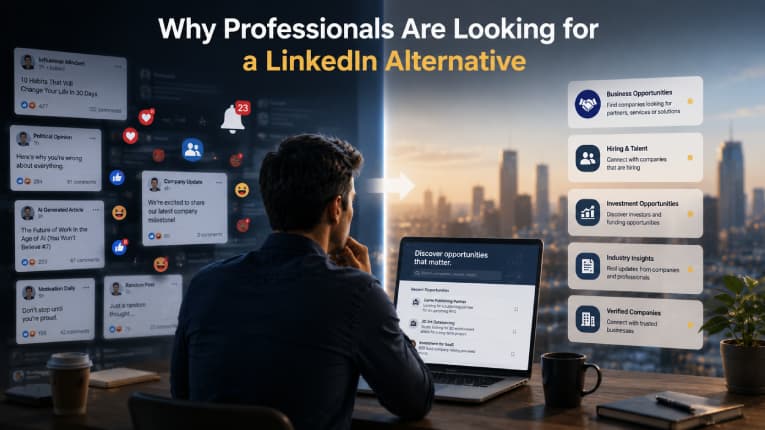
If you've ever opened LinkedIn with a specific goal, you've probably experienced the same frustration. You wanted to find a potential customer, discover a business partner, hire someone for your team or simply understand what was happening in your industry. Instead, you found yourself scrolling through motivational stories, political debates, personal branding posts and AI-generated content that all sounded strangely similar. Somewhere in between, there were genuine business updates and valuable insights, but they were becoming increasingly difficult to find.
This isn't a criticism of LinkedIn alone. It's a broader reflection of what has happened to professional networking over the last decade. Platforms that were originally built to help professionals discover opportunities have gradually adopted the mechanics of consumer social media. Attention became easier to measure than business outcomes, so engagement slowly replaced usefulness as the primary signal. The result is a professional environment where visibility often matters more than relevance.
That's one of the reasons why the search for a LinkedIn alternative has grown so rapidly. Most people aren't looking for another place to post content. They're looking for a place where business once again becomes the center of the experience.
Professional Networking Was Never About Entertainment
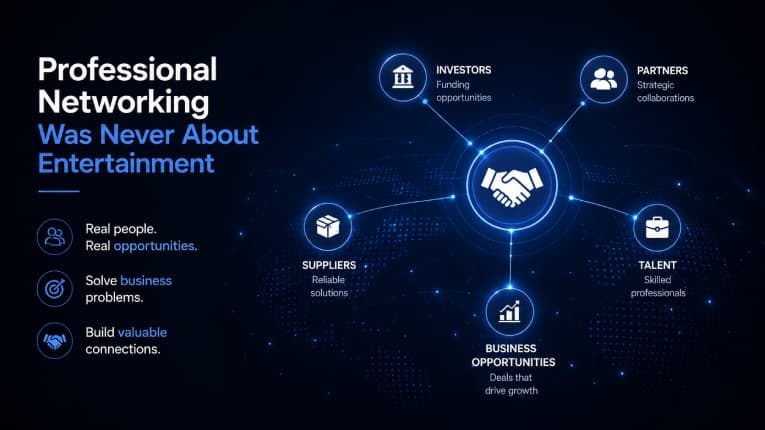
Professional networks became valuable because they reduced the distance between people who could create value for each other. A founder could reach an investor without an introduction. A studio could discover a publisher on the other side of the world. A manufacturer could find a new supplier, and a recruiter could connect with experienced professionals who would have been impossible to reach through traditional channels.
None of those outcomes depended on viral posts or personal influence. They happened because the network made professional discovery easier.
That distinction matters because business networking has a fundamentally different purpose than social media. People don't open a professional platform because they're looking for entertainment. They open it because they're trying to solve a business problem. Every minute they spend there should increase the likelihood of finding useful information, meeting the right person or discovering an opportunity they didn't know existed.
When that stops happening consistently, professionals begin questioning whether the platform is still serving its original purpose.
The Problem Isn't That There's Too Much Content
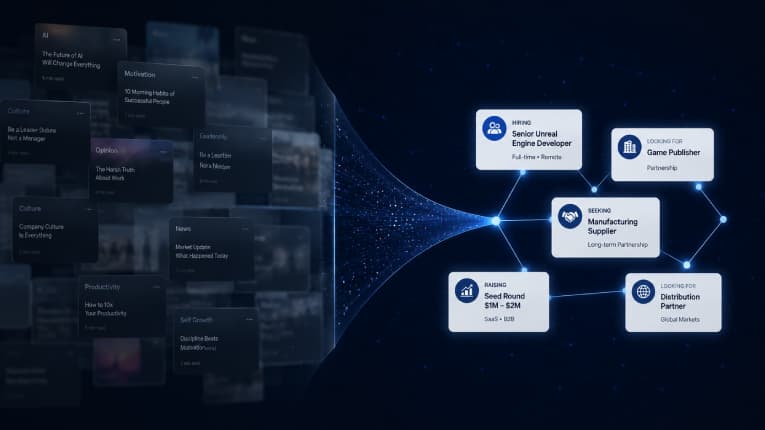
It's easy to blame artificial intelligence for the growing amount of low-value content online, but AI isn't really the problem. It has made publishing dramatically easier, yet easier publishing doesn't automatically produce better knowledge. Every day, thousands of articles, opinions and leadership posts appear online within minutes. Many are well written. Many are visually polished. Very few offer original experience or practical insight.
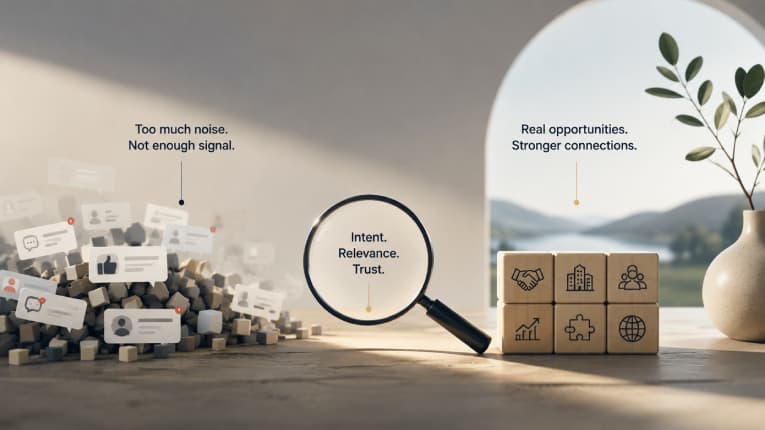
As the volume of content increases, discovering information that genuinely helps people make better business decisions becomes increasingly difficult. Professionals aren't suffering from a lack of information. They're suffering from a lack of relevant information.
That's an important difference.
A recruiter doesn't need another generic article about company culture. A founder doesn't need another motivational story about persistence. A supplier isn't searching for inspirational quotes. They're looking for people, companies and conversations that can move their business forward.
We Keep Talking About Ecosystems, Yet They Rarely Feel Connected
Every industry likes to describe itself as an ecosystem. Whether it's gaming, healthcare, manufacturing, technology or creative industries, the idea is always the same: companies, professionals and organizations are supposed to form a connected network where opportunities naturally emerge through collaboration.
In reality, that's rarely how it works.
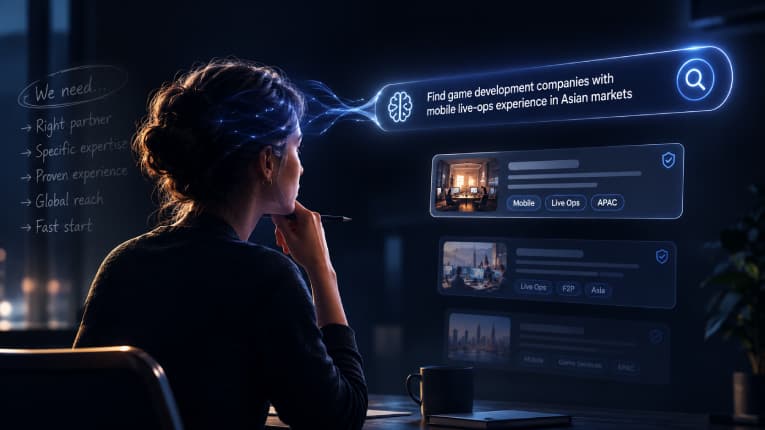
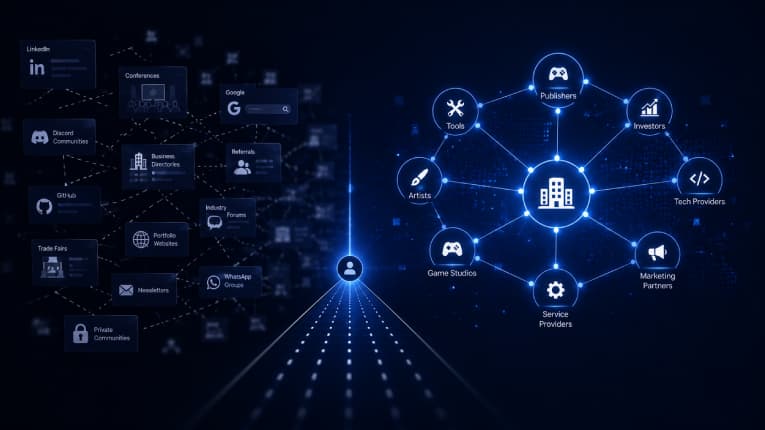
Imagine you're running an independent game studio and you've reached the point where you need a publisher. You know there are dozens of publishers that could be a good fit, but where do you actually find them? You browse LinkedIn, check conference attendee lists, join a few Discord communities, search Google and ask people in your network for introductions. After several hours, you've collected plenty of names but still have no clear picture of which publishers are actively looking for new studios or even open to conversations.
The same pattern exists across almost every industry. A manufacturer searching for a new supplier jumps between trade fairs, business directories and referrals. A recruiter looks through LinkedIn, GitHub and private communities to understand who's actually available. A founder raising investment researches funds, portfolio companies and personal introductions across multiple platforms before even starting a conversation.
The problem isn't that these ecosystems don't exist. The problem is that they're fragmented. Information, relationships and opportunities are spread across dozens of disconnected places, forcing professionals to spend more time searching than connecting.
That fragmentation has another consequence. As professionals move between platforms trying to piece together the information they need, they become increasingly dependent on engagement-driven feeds and recommendation algorithms. Unfortunately, those systems are designed to surface what generates attention, not necessarily what creates business value. That's where professional discovery begins to break down.
Engagement Doesn't Always Create Value
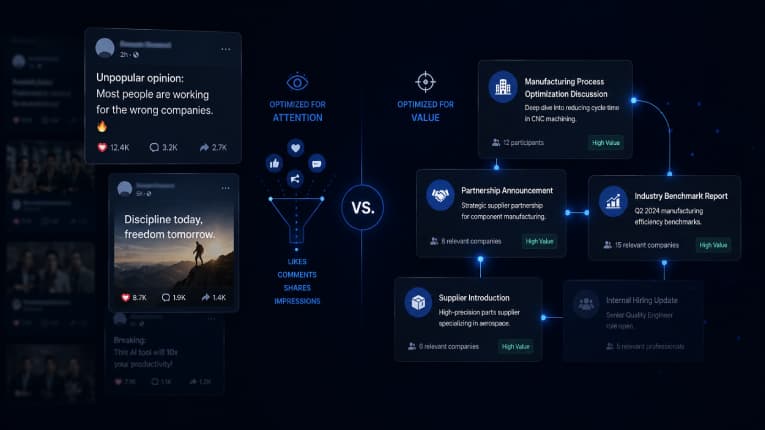
Most social platforms optimize for attention because attention is measurable. This is closely related to the idea behind Discovery Over Attention, where we discuss why relevance should matter more than engagement in professional networking. Likes, comments, shares and impressions are simple metrics that tell platforms what people are interacting with. The more engagement a post receives, the more people are likely to see it.
Business networking doesn't necessarily benefit from that model.
A detailed discussion about manufacturing processes may receive far less engagement than a controversial opinion, yet it can be infinitely more valuable to the professionals who actually work in that industry. A company announcing a partnership with a strategic supplier might only matter to a small audience, but for those companies it could lead to entirely new business relationships.
Professional value isn't always visible through engagement metrics. As we explored in our article on professional analytics and context, engagement metrics rarely tell the full story of professional value.
Sometimes the most important conversations are the ones that only a handful of people need to see.
Maybe Professionals Aren't Looking for Something New
When people search for a LinkedIn alternative, they often describe it as a search for another platform. That may not be entirely accurate. We explore this shift further in our article on the future of professional networking and business discovery, where we discuss what the next generation of professional networks may look like.
Perhaps they're searching for something much simpler.
A professional network where business conversations are easier to find than personal branding.
A place where industry knowledge matters more than engagement.
A place where discovering companies, partners, customers, suppliers and talent takes less effort than filtering through content that was never relevant in the first place. The idea of business discovery itself is explored further in The Next Layer of the Internet Is Business Discovery.
Professional networking didn't become successful because it encouraged people to spend more time scrolling.
It became successful because it helped people spend less time searching.
That's a distinction worth remembering, especially as the next generation of professional networks begins to emerge.