Why Professionals Are Looking for a LinkedIn Alternative for Business Discovery
Professional networking creates visibility, but business discovery helps people find relevant partners, companies and opportunities based on intent and trust.
Professional networking has become easier to access than ever. Professionals can create profiles, find companies, build connections and reach people across industries and countries from a single platform. Yet despite this accessibility, discovering the right business opportunity can still feel surprisingly difficult.
The reason is simple: having access to more people does not necessarily make it easier to find the right people. Professional networks have become very good at helping people build visibility, maintain relationships and share what they are doing. But when the goal is to find a specific partner, company, capability or opportunity, visibility alone does not always solve the problem.
This is the gap between professional networking and business discovery. Networking helps people build relationships, while business discovery helps them find relationships that are relevant to a specific goal. This is why the search for a LinkedIn alternative is becoming increasingly relevant from a business perspective.
The Difference Between Visibility and Discovery
Many professional networking platforms are primarily built around identity and visibility. You create a profile that explains who you are, where you have worked and what you do. You build connections, publish content, follow companies and gradually establish a professional presence that others can discover.
There is clear value in that model. A strong professional profile can establish credibility, content can demonstrate expertise and a broad network can create opportunities that would otherwise never exist. The problem starts when the objective is not simply to become more visible, but to find something specific.
Imagine that a company is looking for a distribution partner in a particular market. A founder may be looking for someone with experience entering that market. A game studio might be searching for a publisher, while a technology company may need a particular service provider. In each of these cases, the challenge is not really gaining more visibility. The challenge is discovering who is relevant to the objective.
This distinction is becoming increasingly important as professional networks grow. A large network can contain thousands of potentially useful people and companies, but the size of the network does not automatically make the right opportunity easier to find.
The Problem With Traditional Professional Networking
Traditional networking tends to begin with identity. You search for a person, look at their profile and decide whether they might be relevant. If they appear relevant, you send a connection request or a message and begin the process of finding out whether there is a meaningful reason for the two sides to talk.
That process works, but much of the context is discovered after the connection has already been initiated. A person's profile might tell you that they work in business development, but it may not tell you that their company is currently looking for distribution partners. A company profile might explain what the company does, but it may not tell you that it is actively searching for a technology provider.
This creates a gap between professional identity and business intent.
The same person can be highly relevant to one professional and completely irrelevant to another. The same company can be a potential customer, partner or supplier depending on what each side is trying to accomplish at a particular moment. When intent is missing from the discovery process, users are often forced to rely on assumptions, broad searches and increasingly personalized outreach.
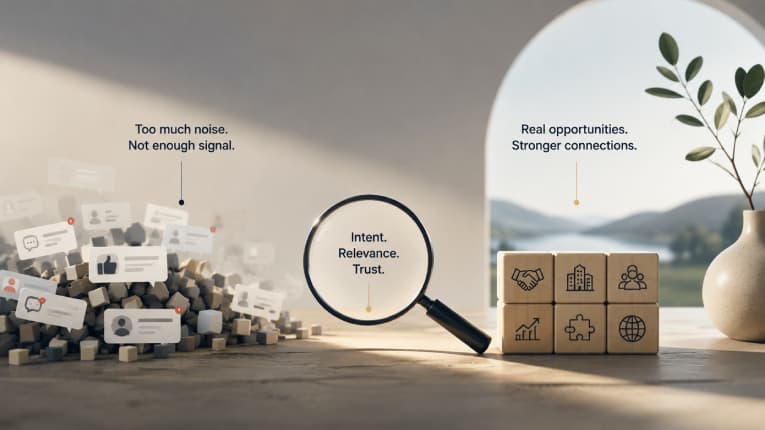
That is one reason professional networking can become noisy even when the underlying network is valuable. More profiles, more content and more connections create more information, but information is not the same thing as relevance.
What Is Business Discovery?
Business discovery approaches the problem from a different direction. Instead of starting with a network and asking which people might be useful, it starts with an objective and asks which professionals, companies and opportunities are relevant to that objective.
The objective could be finding a business partner, discovering a supplier, entering a new market, finding a service provider, hiring specific expertise or identifying a company that needs what you offer. In each case, the important information is not only who someone is, but also what they are trying to accomplish.
This is where intent becomes an important part of professional discovery. Two professionals can have almost identical backgrounds, work in the same industry and have similar experience while having completely different reasons for being on a platform. One might be looking for a new role while the other is looking for a commercial partner. From a profile-based perspective they may look similar. From a business discovery perspective, they represent very different opportunities.
Business discovery therefore adds another layer to professional identity. It considers what someone does, what their company does, what they can offer and what they currently need. The purpose is not simply to create a larger network, but to make the existing network more useful.
Relevance Also Requires Trust
Finding someone who appears relevant is only the beginning of a potential business relationship. Before starting a conversation, people also need enough context to decide whether that relationship is worth pursuing.
This is where trust becomes part of business discovery. A profile can contain useful information, but business decisions often require more than a name, job title and company description. People want to understand whether the information is credible, whether the company and professional are actually associated with the stated business and whether there is a legitimate reason for the two sides to talk.
Verification does not remove every uncertainty from a professional relationship, nor should it be treated as a guarantee of a successful partnership. What it can provide is an additional layer of context and confidence when evaluating potential business connections.
This becomes particularly relevant as digital professional networks continue to grow. The easier it becomes to create profiles and contact large numbers of people, the more valuable reliable context becomes. Discovery is not only about finding someone who looks relevant. It is about having enough information to understand why the relationship might make sense.
What Should a Professional Networking Alternative Do Differently?
A useful alternative should not simply reproduce the same networking model with a different interface. The more important question is whether it makes the discovery process more relevant.
For professionals, that means being able to communicate more than a job title and employment history. It means having a way to express what they offer, what they need and what kinds of business relationships they are interested in. For companies, it means being discoverable based not only on their identity, but also on their capabilities, needs and opportunities.
The discovery process should also provide enough context before someone initiates contact. If you can understand why a person or company might be relevant before sending a message, the conversation starts from a different place. Instead of a generic introduction followed by several messages trying to establish context, both sides can begin with a clearer understanding of the potential value.
This does not mean that traditional professional networking becomes obsolete. Profiles, content, connections and visibility still have a role. The difference is that they should not have to carry the entire burden of business discovery.
A Different Approach to Professional Networking
This is the problem UmayNow addresses through a business discovery approach to professional networking. The goal is not simply to help people build a larger network or compete for attention in a crowded feed. It is to help professionals and companies discover something useful and be discovered when they have something useful to offer.
Instead of asking users to search through profiles without a clear purpose, UmayNow is built around the needs, offers and intentions that make a professional connection relevant. This gives people and companies more context for deciding where a conversation may be worth starting.
That changes the role of intent. What someone needs or offers becomes part of the discovery context rather than something that has to be explained after a connection has already been made. A company looking for a particular capability, a professional offering a specific service or two businesses looking for a potential partnership can become part of the same discovery process.
It also changes the role of content. Content can still be useful for demonstrating knowledge and establishing credibility, but business discovery does not need to depend on who is publishing the most or receiving the most attention. The objective is relevance rather than reach alone.
You can read more about this shift in The Future of Professional Networking Is Business Discovery, where we explore why business discovery may become a distinct layer of professional networking.
The Future of Professional Networking May Be About Finding the Right Thing
Professional networking is unlikely to stop being about people. Professional identity, reputation, content and relationships will continue to matter because they provide the context in which business relationships are built.
What may change is how those relationships are discovered.
The next generation of professional networking can combine identity with intent, relevance and trust. Instead of asking only who someone is, a discovery system can also consider what they are looking for, what they can offer and whether there is a meaningful reason for two sides to connect.
That does not require professionals to abandon the platforms they already use. A LinkedIn alternative for professionals does not necessarily have to replace every existing networking function. It can address a different part of the problem.
Because when you are looking for a partner, client, supplier, advisor or business opportunity, the goal is rarely to find more people.
It is to find the right one.
If you are looking for a more relevant way to discover professionals, companies and business opportunities, explore UmayNow and see how professional networking can work around business discovery.