Why Fake Job Listings Are Becoming a Bigger Problem
Fake job listings are becoming increasingly difficult to distinguish from legitimate opportunities. Here's why they're on the rise and why trust matters more than ever.
Spend enough time on any professional platform and you'll eventually come across a job posting that doesn't feel quite right.
Sometimes it's a company you've never heard of. Sometimes the salary seems unusually generous. Other times everything looks perfectly legitimate until the conversation moves outside official channels.
Looking for a new job has always required a certain level of caution, but today that caution matters more than ever. A recent Resume Genius survey found that 67% of job seekers have encountered job postings they believed were fake or misleading. That statistic reflects something many professionals have already noticed firsthand: fake job listings are becoming increasingly difficult to distinguish from legitimate opportunities.
Poorly written ads filled with spelling mistakes and unrealistic promises haven't disappeared, but they're no longer the only threat. AI tools can now generate convincing job descriptions, realistic company profiles and professional recruiter messages within minutes. As a result, many fake job listings look almost identical to legitimate opportunities, making them difficult to recognize even for experienced professionals.
Why Fake Job Listings Have Become So Difficult to Spot
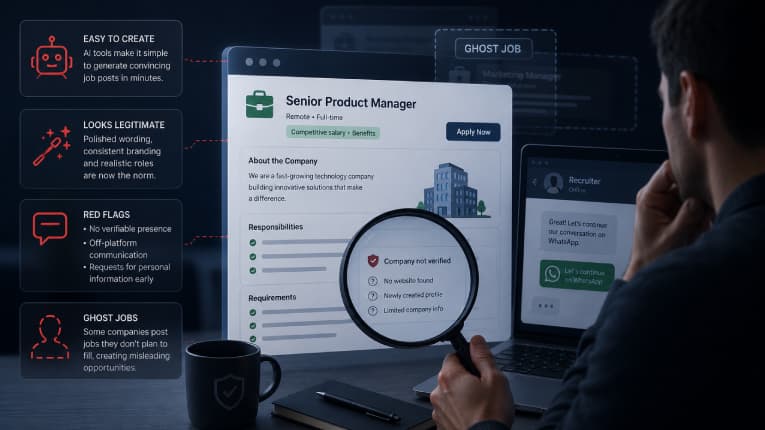
One of the biggest reasons is that creating a convincing job post has become remarkably easy. The same technology that helps legitimate companies write better job descriptions is also available to people who want to imitate them. None of that is inherently suspicious. The problem is that professionalism can now be replicated with very little effort.
That has changed the nature of fake job listings. Years ago, many of them were easy to spot because they contained obvious mistakes or unrealistic promises. Today, the opposite is often true. The wording is polished, the branding looks consistent and the role itself may sound perfectly legitimate. What happens around a job posting often tells you far more than the posting itself.
That's why experienced professionals tend to look beyond the description. A company with no verifiable online presence, a recruiter who immediately moves the conversation to a personal messaging app or a request for sensitive information before an interview has even taken place are all warning signs that deserve a closer look.
Not every misleading job posting is part of a scam. Some companies advertise positions they have little or no intention of filling, often referred to as ghost jobs. While these listings aren't necessarily fraudulent, they contribute to the same problem by making it harder for professionals to know which opportunities are genuinely available.
The Real Cost Isn't Just Wasted Time
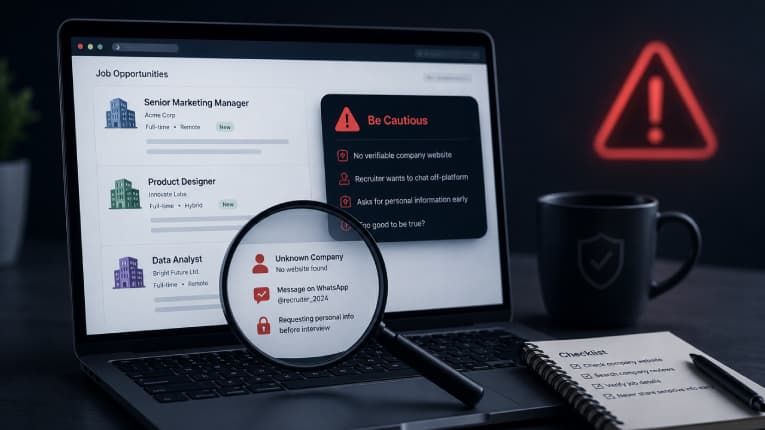
When people talk about fake job listings, the conversation usually focuses on the candidates who apply. That's understandable, but it's only part of the picture.
Fake job listings don't just waste time. They can also lead to significant financial losses. According to the U.S. Federal Trade Commission (FTC), reported job scams have cost Americans hundreds of millions of dollars each year, with reported losses continuing to rise as fraud becomes more sophisticated.
The damage also extends to legitimate employers. Companies whose identities are copied may find themselves responding to confused applicants. Recruiters spend more time proving they're genuine before they can even discuss the role, while professionals become increasingly skeptical of every opportunity they see, including legitimate ones.
Trust works much like reputation. It takes a long time to build and only a handful of bad experiences to weaken. Once professionals start questioning whether a vacancy is genuine, the hiring process becomes less efficient for everyone involved.
Verification Is Becoming More Important Than Visibility
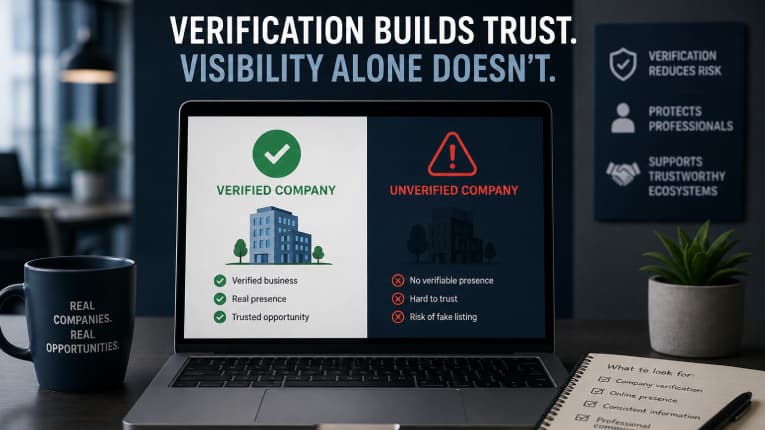
For years, professional platforms competed by helping people discover more opportunities. Today, that isn't enough. If users can't tell which companies are genuine, showing them a larger number of vacancies doesn't necessarily improve the experience.
Company verification doesn't eliminate every fake job listing, but it does make trust easier to establish. When professionals can immediately see that a business has been verified, they spend less time questioning whether a company is real and more time evaluating whether the opportunity is right for them.
We explored this topic in Why Company Verification Matters in B2B Discovery, where we explain why verification is becoming a fundamental part of building trustworthy professional ecosystems, not just a feature for recruitment platforms.
Trust Shouldn't Start After You Apply
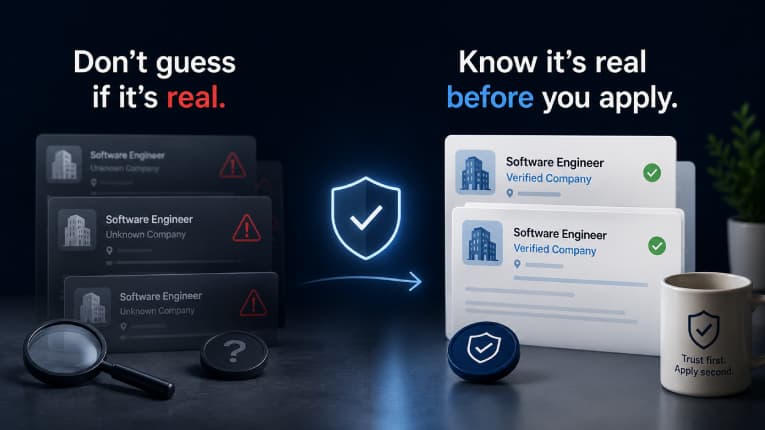
Most professionals don't expect every opportunity to be the right fit. They do expect it to be real.
As fake job listings become more sophisticated, trust is becoming just as important as discovery. The platforms that earn professionals' confidence won't necessarily be the ones with the most opportunities. They'll be the ones that make it easier to recognize the real ones before professionals invest their time, share their information or decide to apply.
Trust doesn't end once someone applies for a role. Understanding how professionals and companies interact after that first connection is just as important. We explored that perspective in Beyond Profile Views: Why Professional Analytics Need Context.