Traditional Networks Are Great for Visibility. Not Discovery.
Traditional Networks transformed professional networking by making professionals and businesses more visible. But as AI creates more content and professional ecosystems become increasingly crowded, visibility alone is no longer enough. This article explores why discovery is emerging as the next evolution of professional networking and how AI-powered business discovery can help companies find the right partners, opportunities and collaborations before they even start searching.
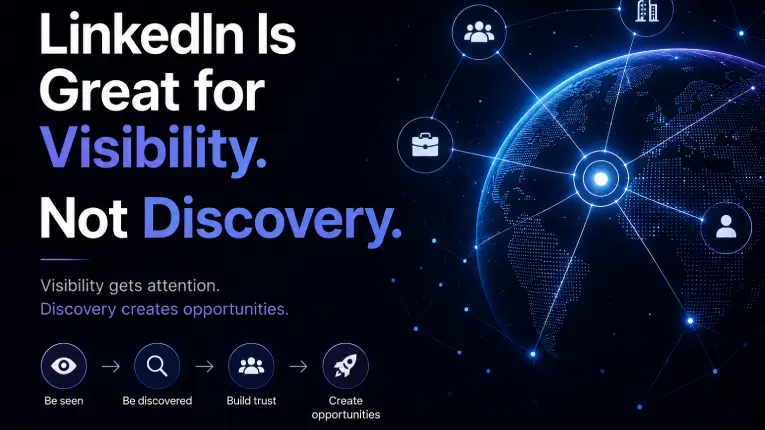
LinkedIn Is Great for Visibility. Not Discovery.
Visibility gets attention. Discovery creates opportunities.
For more than two decades, LinkedIn has shaped professional networking. It gave people a place to build a digital identity, helped companies establish credibility beyond their websites and made it easier for recruiters, founders and business leaders to connect. At a time when professional visibility barely existed online, LinkedIn solved a genuine problem and changed the way careers and businesses grew on the internet.
That problem, however, is no longer the one holding businesses back.
Today almost every professional has an online profile. Companies publish updates daily, executives share insights and organizations invest significant time building their digital presence. Becoming visible is no longer a competitive advantage. It's simply part of participating in modern business.
Yet despite having more platforms, more professional content and more ways to connect than ever before, companies still spend an extraordinary amount of time searching for the right partners, suppliers, clients and collaborators. Businesses move between search engines, professional networks, referrals, conferences and private communities before they feel confident enough to make an important decision.
The internet made businesses easier to see.
It didn't necessarily make them easier to discover.
Visibility Solved Yesterday's Problem
Visibility and discovery are often treated as if they describe the same experience, but they solve two completely different problems.
Visibility answers a simple question. Can people find your company?
Discovery asks something much more valuable. Can the right people find your company when your expertise becomes relevant to their business?
That difference is easy to overlook because visibility is measurable. Followers, impressions, profile views and engagement all provide clear signals that something is happening. Discovery is much harder to measure because it happens at the moment opportunity and capability intersect.
Imagine a cybersecurity company that regularly publishes research, speaks at conferences and has built a respected brand within its industry. Thousands of professionals know it exists. Yet a manufacturing company facing a security challenge may never encounter that business while searching for a solution. The cybersecurity company isn't invisible. It simply wasn't discovered when it mattered most.
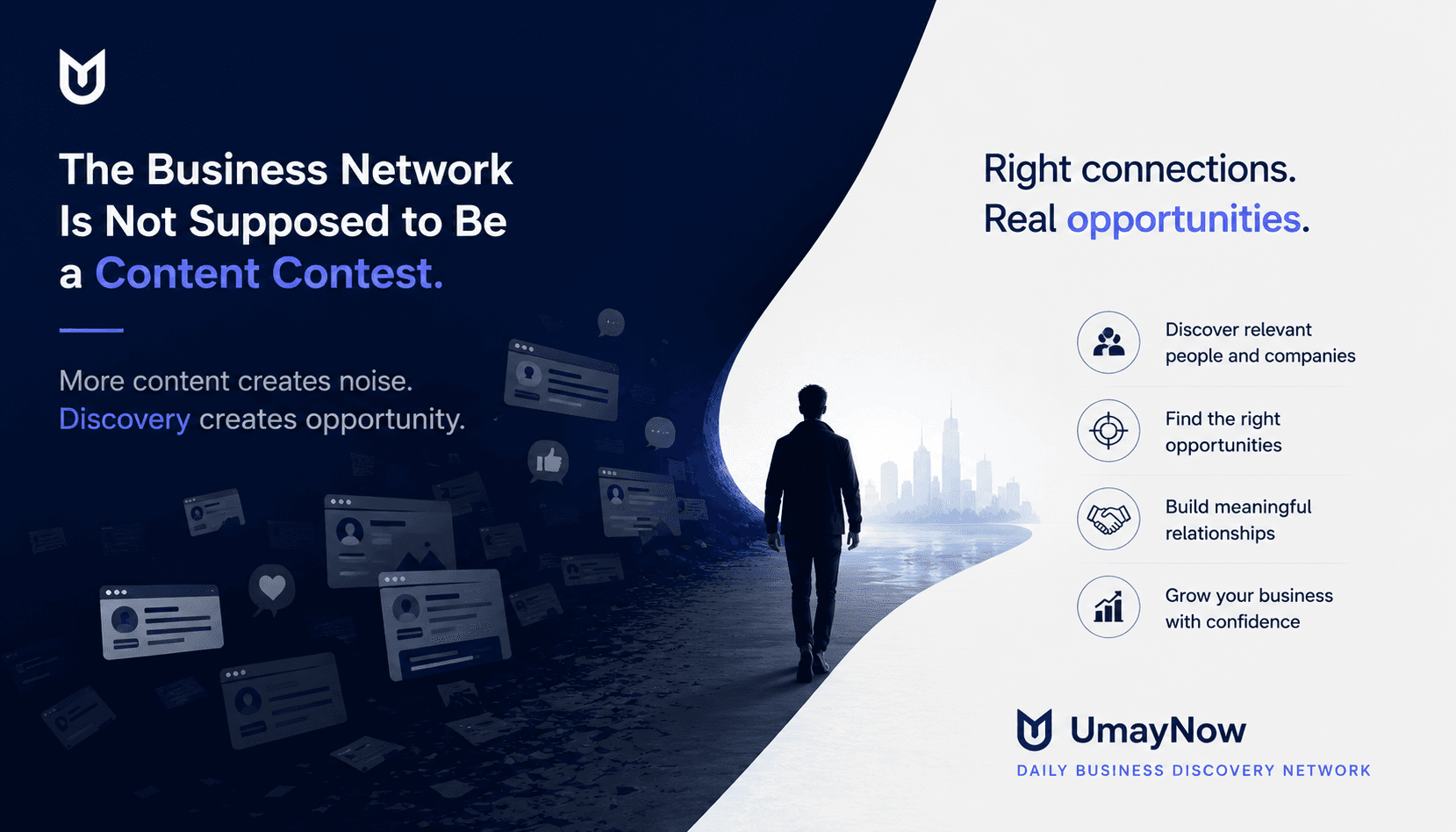
For years we've assumed that producing more content naturally creates more opportunities. Sometimes it does. More often, it simply creates more visibility within an increasingly crowded environment.
The Content Explosion Changed the Rules
Artificial intelligence has transformed professional publishing faster than almost anyone expected.
Articles that once required days of research can now be drafted in minutes. Marketing teams produce newsletters faster, founders share ideas more frequently and companies of every size have access to tools that dramatically reduce the cost of creating content.
This is undoubtedly a positive development, but it has also changed the economics of attention.
When everyone can publish, publishing itself stops being a differentiator.
Every day millions of professionals compete for the same finite resource: attention. The result isn't a lack of information but an overwhelming abundance of it. Businesses don't struggle because there are too few experts available. They struggle because identifying the right expert has become increasingly difficult.
Content remains one of the best ways to communicate expertise, but business relationships rarely begin because someone happened to read the perfect post. They begin when a company reaches a point where external expertise becomes necessary.
A manufacturer expands into a new region and needs a logistics partner. A game studio prepares for an international launch and starts looking for a localization company. A growing startup needs legal support before raising investment.
The opportunity already exists.
The challenge is making sure the right businesses discover one another before weeks of manual research begin.
Search Was Never Designed for Discovery
Search engines remain one of the most valuable technologies on the internet. They answer questions remarkably well because every search begins with a clear intention. You type keywords because you already have a reasonable idea of what you're looking for.
Business development rarely works that way.
Many of the most valuable partnerships happen between companies that had never heard of each other before a project brought their paths together. The ideal supplier may never appear because nobody searched using the right terminology. A specialized consultancy may solve exactly the problem you're facing without ranking highly in search results. An innovative startup may never enter the conversation simply because it sits outside your existing network.
Search helps us find information.
Discovery helps us uncover possibilities we didn't know existed.
That's a subtle distinction, but it changes how businesses grow. The companies creating the greatest value aren't always the most visible ones. They're often the ones that become discoverable at exactly the right moment.
Professional Networks Optimize the Wrong Signals
If discovery is still difficult, it's worth asking why professional platforms haven't solved it already.
The answer is surprisingly simple. Most professional networks weren't built to optimize business outcomes. They were built to maximize engagement.
That doesn't mean they're failing. It means they're solving a different problem.
Social platforms are designed to answer questions like: What content should people see next? What keeps users engaged? What encourages interaction? Those objectives make perfect sense for a platform built around conversations and content.
Business decisions follow a different logic.
When a company is looking for a manufacturing partner, a legal advisor or a software vendor, popularity isn't the deciding factor. Decision makers care about experience, reliability and the confidence that a partner can deliver. Those signals don't always generate likes or comments, but they're often what determines whether a partnership succeeds.
This creates an interesting gap. Businesses are expected to make critical decisions using platforms that primarily surface content instead of operational context. The result is that organizations often spend more time validating potential partners than they do discovering them.
Discovery Needs Context, Not Just Data
Context is what turns information into understanding.
Two companies can describe themselves using almost identical language. Both might claim to specialize in digital transformation, AI consulting or software development. On paper, they appear interchangeable.
In reality, they may be completely different.
One may have spent years working with healthcare organizations navigating strict regulatory requirements. The other may have built enterprise software for global logistics companies. Their websites may look similar, but their experience, capabilities and business ecosystems are not.
This is where discovery begins to separate itself from search.
Search matches keywords.
Discovery matches context.
It considers the kinds of problems a business has solved, the industries it understands, the partnerships it has built and the experience it has accumulated over time. Those signals provide a much clearer picture than a profile or a collection of posts ever could.
Artificial intelligence will certainly accelerate this shift, but AI alone isn't the answer. Models can organize information, summarize documents and identify patterns at extraordinary speed. They cannot create context that doesn't exist.
If professional platforms continue organizing information around profiles, keywords and engagement metrics, AI will simply become better at recommending profiles, keywords and engagement metrics. Better recommendations don't automatically create better business relationships.
Discovery requires richer information before intelligence can make meaningful connections.
The Next Evolution of Professional Networking
Consider how a business opportunity unfolds today.
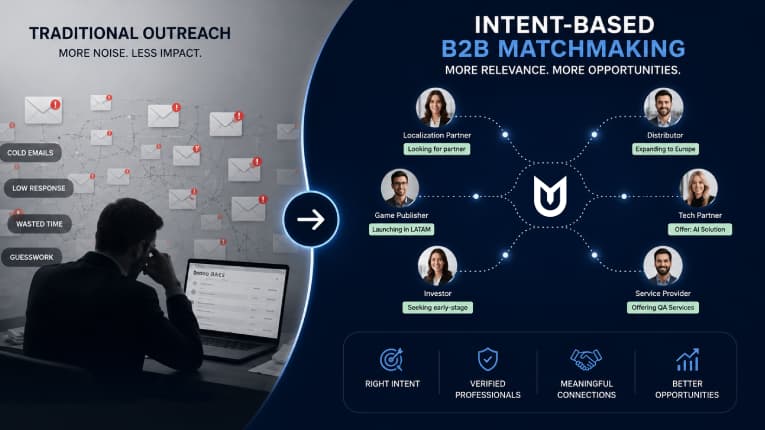
A company decides to expand into Japan and begins searching for a localization partner. The process usually starts with Google searches, LinkedIn profiles, agency directories, referrals and countless browser tabs. Teams compare portfolios, schedule introductory meetings and spend days or even weeks narrowing down their options.
Now imagine a different experience.
Instead of beginning with search, the company is introduced to organizations whose expertise, previous projects, industry knowledge and trusted relationships already align with its goals. Rather than sorting through hundreds of possibilities, the team starts with a handful of highly relevant ones.
The opportunity hasn't changed.
The amount of information hasn't changed.
What changed is the quality of discovery.
As industries become more specialized and global collaboration becomes the norm, this approach becomes increasingly valuable. Businesses don't need more information. They need better ways to identify the information that actually matters.
Where UmayNow Fits
At UmayNow, we believe professional networking is entering its next chapter.
Visibility will always remain important. Businesses need ways to communicate who they are, what they build and what they believe. Content will continue to educate, inspire and build trust.
But trust alone doesn't guarantee discovery.
Our vision is to help businesses become discoverable through operational context rather than visibility alone. That means looking beyond profiles and engagement to better understand capabilities, experience, business relationships and the ecosystems companies operate within.
We don't see this as replacing platforms like LinkedIn.
LinkedIn transformed professional visibility and continues to play an essential role in how people build careers and organizations communicate with the world. Discovery simply addresses a different challenge, one that has become increasingly important as business networks grow larger and opportunities become harder to identify.
Looking Beyond Visibility
For years, we've measured professional success through reach. More followers, more impressions and more engagement became indicators of growth because they were easy to quantify.
The next generation of professional networking may measure something very different.
Not how many people saw your business.
But how many meaningful opportunities found it.
That shift may seem subtle, but it changes how we think about networking, partnerships and growth. Visibility helps businesses establish a presence. Discovery helps them create outcomes.
As artificial intelligence reshapes the way information is created and consumed, helping businesses publish more content is unlikely to be the biggest opportunity. Helping the right businesses find each other at exactly the right moment might be.
And that may become the most valuable connection of all.