The Business Network Is Not Supposed to Be a Content Contest
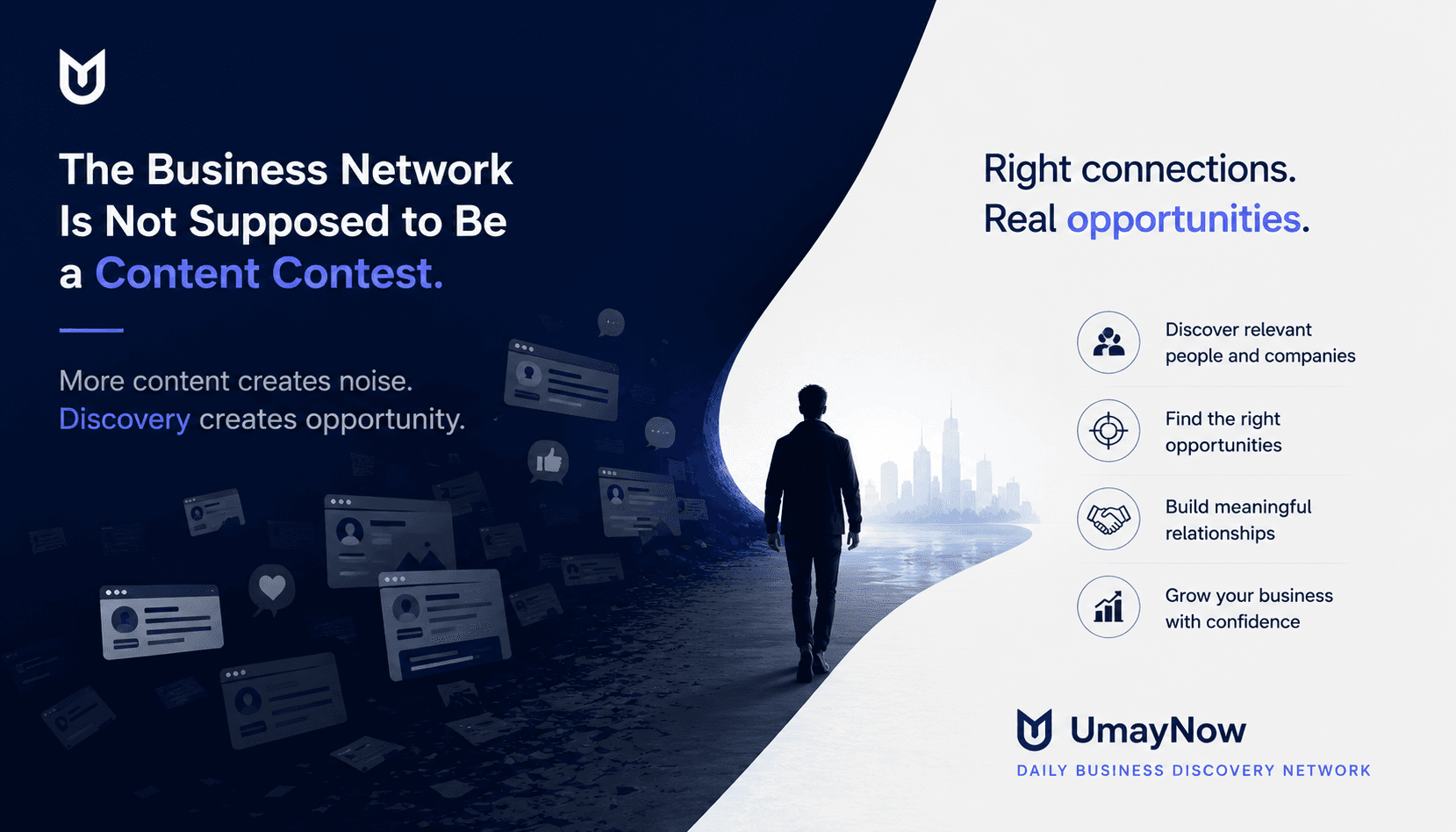
Professional networks were built to help people discover one another. But as visibility and content became the center of the experience, professional networking started to look more like a content contest. The next generation of business networks should focus on relevance, intent and discovery instead.
There was a time when professional networks primarily existed to help people discover one another. You joined to find a company, meet a potential partner, hire someone, explore a market or start a conversation that might eventually become a business relationship. Content was part of that experience, but it was not the reason the network existed. The network was the infrastructure that made professional relationships easier to find and maintain.
Somewhere along the way, that relationship changed. Visibility became one of the most valuable currencies on professional platforms, and professionals were increasingly encouraged to publish more, react faster, build audiences and turn their professional identities into a continuous stream of content. The question gradually shifted from “Who should I meet?” toward “How can I get more people to see me?” That may sound like a small change in emphasis, but it fundamentally changes what a professional network is designed to optimize for.
When Visibility Becomes the Goal
Today, LinkedIn is often treated less like a business network and more like a professional visibility platform. Founders publish lessons about founding, recruiters publish lessons about hiring, marketers publish lessons about marketing and consultants publish lessons about becoming more visible on LinkedIn. An entire ecosystem has developed around understanding how to get more reach, more engagement and more attention from the platform itself.
There is nothing inherently wrong with wanting visibility. Businesses need attention, professionals need ways to communicate what they know and useful content can absolutely create valuable relationships. The problem begins when visibility becomes a substitute for relevance. Being seen by more people is not necessarily the same thing as being discovered by the right person, and the distinction becomes especially important when the objective is not simply awareness but an actual business relationship.
A company looking for distributors does not necessarily need millions of impressions. It needs to be discovered by distributors entering the right market. A software team does not need to become an influencer simply because it has a technical capability that another company needs. It needs to be found by companies facing a relevant problem. A founder looking for a strategic partner does not necessarily need a larger audience either. They need to find someone whose capabilities, interests and timing make the relationship worth exploring.
Those are not visibility problems. They are discovery problems, and they require different infrastructure.
The AI Content Loop
Artificial intelligence has made the visibility race even more intense because producing professional content has become dramatically easier. A single idea can now be transformed into a long-form article, a thread, a carousel, a newsletter and multiple variations of the same opinion within minutes. The barrier to publishing has fallen, but professional networks can now accumulate content much faster than people can meaningfully process it.
Recent analysis from Pangram Labs illustrates part of this change. In an analysis of more than one million social media posts, the company reported that more than 40% of long-form LinkedIn posts in its dataset were classified as fully AI-generated. This should not be read as a claim about every LinkedIn post, but it does show how quickly automated content has entered professional communication.
The deeper problem is not simply that some of this content is bad. Much of it can actually be well-written, informative and perfectly reasonable to read. The problem is that content can begin to look like activity without necessarily representing capability, intent or trust. A well-written post can tell you something about how someone communicates while telling you very little about whether their company is the right partner for your business. A profile can have thousands of connections and years of activity while still providing almost no meaningful signal about what that person or organization is actually looking for today.
As the volume of professional content increases, the existence of more information does not automatically produce better discovery. In some cases, it creates another layer of noise between people and the opportunities they actually need.
The Network Is Still Valuable
None of this means LinkedIn is irrelevant. It remains one of the most recognizable places for professional identity online, used by professionals and companies around the world to represent their experience, establish credibility, communicate ideas and maintain business relationships. The platform has created enormous value by making professional identities easier to find and professional relationships easier to maintain on a global scale.
That is precisely why the direction of professional networking matters. When a professional network becomes increasingly associated with personal branding, engagement tactics and constant publishing, the network can begin to reward the ability to perform professionally rather than the ability to create value professionally. Those two things can overlap, but they are certainly not the same.
Someone can spend years building valuable expertise without becoming particularly good at publishing. A company can create an excellent product without having a sophisticated content strategy. A highly capable professional can be exactly the person another company needs and still remain difficult to discover simply because they are not actively competing for attention. If professional visibility increasingly depends on how consistently someone can produce content, then content production quietly becomes part of the price of admission to the network.
Elon Musk has publicly described LinkedIn posting as “cringe.” His opinion is subjective, and it is hardly a serious assessment of the platform’s value. Still, the fact that this criticism is familiar to many professionals points to a broader discomfort with professional communication that can feel overly polished, performative or disconnected from real work.
A business network should not require everyone to become a creator before they can become discoverable.
Business Is Not Built on Impressions
Real business relationships are rarely formed because someone received the most impressions that week. They are formed because two companies have complementary capabilities, because one organization is entering a market where another already has experience, because a team has a need that another team can actually solve or simply because the timing is right and the people involved have enough context to trust one another.
Followers can help create awareness, and likes can indicate that something attracted attention, but neither tells you whether there is a meaningful business fit. A profile view tells you that someone looked at a profile, but it does not necessarily tell you why they looked, what they were looking for or whether there is an opportunity behind that visit. These metrics are not useless; they simply answer different questions from the ones businesses need answered when they are trying to make decisions.
Imagine a company searching for a technical partner. The number of followers a potential partner has is probably not the most important piece of information. What matters is whether they have the relevant capabilities, whether they have experience in the right market, whether they are interested in the type of collaboration being considered and whether there are enough trust signals to justify starting a conversation. The same applies to hiring, partnerships, suppliers, investors and many other forms of professional discovery.
The challenge, then, is not simply to get more people to see more things. It is to help people discover the things that are actually relevant to them.
What Comes After Professional Networking?
The next generation of business networks should not ask every professional to become a content creator simply to remain visible. It should help the right people and companies discover one another based on what they offer, what they need, what they have done and what they are actively looking for.
That requires a different approach to professional profiles. Traditional profiles are useful because they tell us who someone is, where they have worked and what they have done, but much of that information describes the past. Business opportunities are often determined by what someone can do now, what their organization needs now and whether there is a reason for another person or company to discover them at this particular moment.
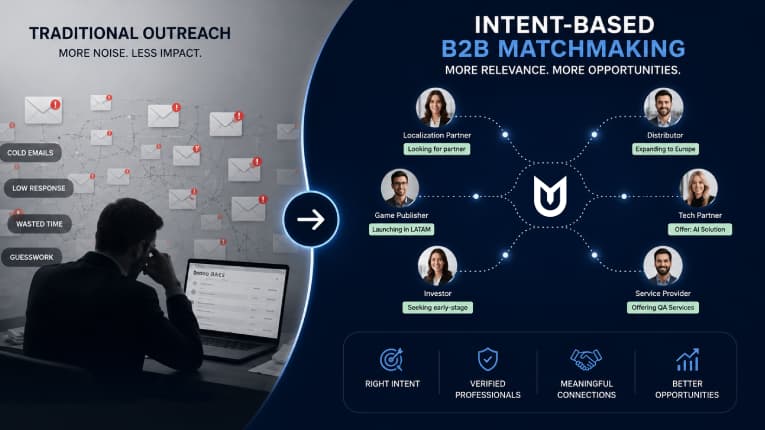
A company might be looking for a distributor in a new market. A developer might be interested in joining a particular type of project. A founder might be looking for an investor or strategic partner. A studio might need a publisher with experience in a particular market. A professional might have a capability that another company urgently needs, even though neither side has published anything about it publicly. Those signals can exist long before a post is written about them.
This is why a professional network should not only answer the question “Who are you?” It should also provide enough context to understand what you can offer, what you are looking for and why another person or company might benefit from discovering you now. That is the difference between a professional social network and a business discovery network. One is primarily designed around identity, relationships and content, while the other is designed around finding relevant people, companies and opportunities.
Discovery Before Content
At UmayNow, we believe business discovery should begin before the first post. A company should not have to build a large audience before becoming discoverable, and a professional should not have to publish every day before relevant opportunities can find them. A potential partner should not become effectively invisible simply because they are not actively competing for attention during a particular week.
This does not mean that content has no place in a business network. Content can demonstrate expertise, communicate ideas and provide context around the people and companies behind a potential relationship. The difference is that content should support discovery rather than become the condition for it. Your expertise should not become invisible because you are not publishing this week, and your company should not become less relevant simply because another company is better at generating engagement.
A useful business network should have enough context to recognize that two people or companies may be relevant to one another even when neither of them is trying to capture an audience. Their capabilities may complement each other, their needs may overlap, their experience may be relevant or their current intentions may create a reason to start a conversation. That information can be valuable even when there is no viral post, no large audience and no engagement spike attached to it.
This is where business discovery becomes fundamentally different from content distribution. Content distribution is concerned with how effectively information reaches an audience. Business discovery is concerned with whether the right person or company can find the right opportunity when there is a genuine reason for that connection to exist.
From Audience Building to Opportunity Finding
The internet has become exceptionally good at distributing information. Search engines organize pages, social networks distribute content, algorithms measure engagement and AI systems can summarize enormous amounts of information in seconds. What remains less solved is the problem of helping people discover what actually matters to them, when it matters and with enough context to know whether they should act on it.
That problem becomes more important as the amount of professional information continues to grow. If everyone can produce more content, producing more content cannot remain the only path to professional visibility. If professional communication can increasingly be automated, the sheer volume of communication becomes a weaker signal on its own. What becomes more valuable is the context behind the people and companies inside the network: what they can do, what they need, what they are looking for, where they have experience, who they could potentially work with and what signals exist to establish trust.
The future of professional networking should not be an endless competition to produce more content than everyone else. It should be a more effective way to find the people, companies and opportunities that are actually relevant, including the opportunities that might otherwise remain hidden simply because nobody happened to publish about them.
Because the goal of a business network is not to make everyone visible to everyone. It is to make the right opportunity discoverable by the right person at the right time.
That is the shift from attention to discovery.
And it is the infrastructure UmayNow is building.