Why Trust Matters More Than Followers
The internet learned how to measure attention. Business has always depended on something much harder to measure: trust.
Why Trust Matters More Than Followers
When social media became the default way we communicate online, it changed more than how we share ideas. It also changed how we evaluate credibility. Over time, follower counts, likes and engagement became universal signals of influence. They were easy to understand, easy to compare and impossible to ignore. The larger someone's audience became, the more likely we were to assume they knew what they were talking about. Eventually, popularity stopped being just another metric and quietly became a substitute for trust.
That assumption works surprisingly well in some parts of the internet. If you're looking for entertainment, lifestyle content or consumer recommendations, popularity can be a useful signal. Millions of people watching the same film, listening to the same artist or following the same creator usually tells us something worth knowing.
Business has never worked that way.
The companies we choose to work with are rarely the ones with the largest audiences. Investors don't fund founders because they regularly go viral. Manufacturers don't select suppliers based on engagement rates, and publishers don't sign long-term partners because they have impressive follower counts. When real projects, real budgets and real reputations are involved, people stop asking who is the most visible and start asking who is the most reliable.
That difference matters more than most digital platforms acknowledge.
Visibility Was Never the Same as Credibility
One of the internet's greatest achievements was making attention measurable. Today we know which videos were watched the most, which articles were shared the fastest and which creators gained the largest audiences. Every major platform has become remarkably good at understanding what captures people's attention, because attention is relatively easy to quantify.
Credibility isn't.
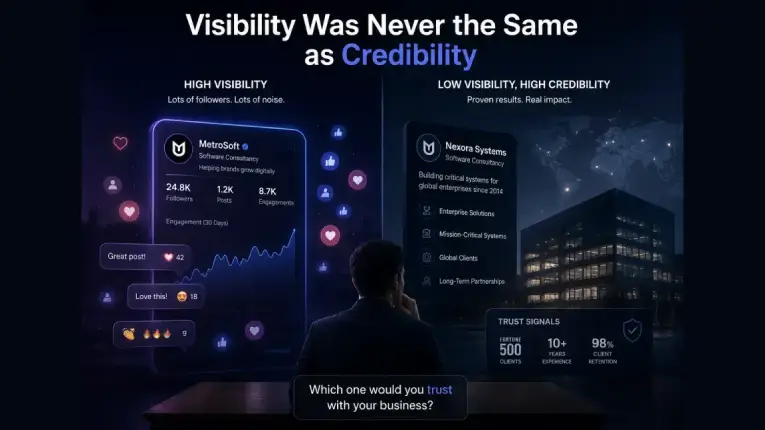
Imagine two software consultancies. One publishes content every day, has tens of thousands of followers and receives constant engagement on social media. The other rarely posts online but has spent the last decade building critical systems for global companies. If you were choosing a partner for a project that your business depended on, which one would you trust?
Most experienced decision makers already know the answer.
Business has always rewarded competence more consistently than visibility. The problem is that the internet has spent the last twenty years making visibility obvious while leaving competence much harder to discover.
Trust Doesn't Appear Overnight
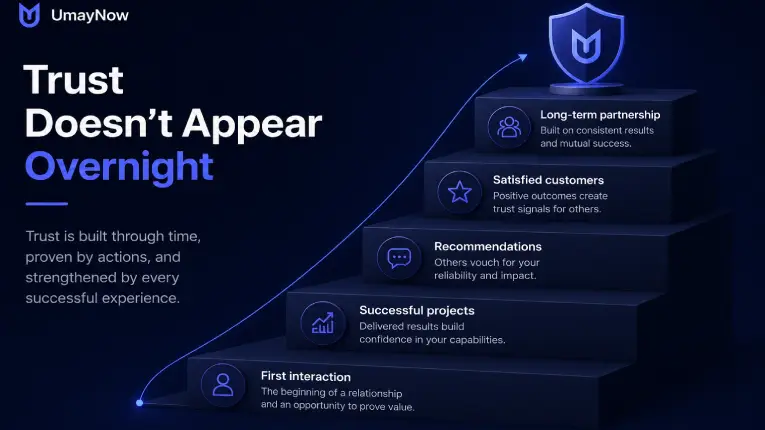
Trust is rarely created by a single interaction. It grows through repeated experiences, successful projects and promises that are consistently kept over time. Every completed collaboration, every recommendation and every satisfied customer adds another layer of confidence that can't be captured by a follower count.
Think about the last important business decision you made. Whether you hired a consultant, selected a supplier or explored a strategic partnership, you probably weren't looking for the person with the biggest audience. You wanted evidence. You wanted to know whether they had solved similar problems before, whether they understood your industry and whether other people trusted them enough to work with them again.
In other words, you weren't evaluating popularity.
You were evaluating risk.
Trust has always been the mechanism businesses use to reduce uncertainty. Long before the internet existed, companies relied on reputation because reputation was often the best predictor of future performance. Digital platforms changed how we communicate, but they never changed how decisions are made.
The Internet Organized Information. It Never Organized Trust.
Over the past three decades, the internet has become remarkably good at organizing almost everything. Search engines made information instantly accessible. Social platforms mapped relationships between people. Professional networks gave us digital identities, while streaming services became so good at understanding our preferences that they could recommend films, music and books before we even thought to search for them.
Each generation of internet products solved a different discovery problem.
Yet one layer remains surprisingly underdeveloped.
Trust.
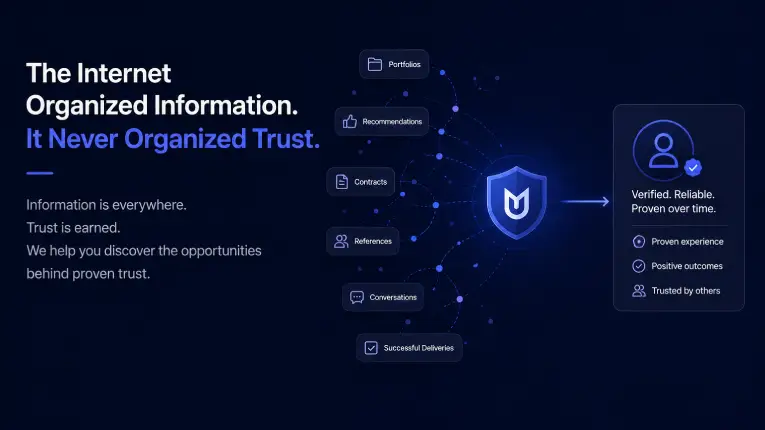
Not because trust doesn't exist, but because it doesn't live in one place. It emerges from years of collaboration, professional reputation, client relationships, successful deliveries and accumulated experience. Some of those signals exist inside portfolios. Others live in references, contracts, recommendations or conversations that never become public. They are scattered across hundreds of small interactions that, together, tell us whether someone is genuinely reliable.
The internet became incredibly good at indexing information.
It never became equally good at indexing confidence.
Why AI Makes This Even More Important
Much of the conversation around artificial intelligence has focused on search. Will people still use search engines? Will AI replace directories? Will websites receive less traffic?
Those are important questions, but they may not be the biggest change.
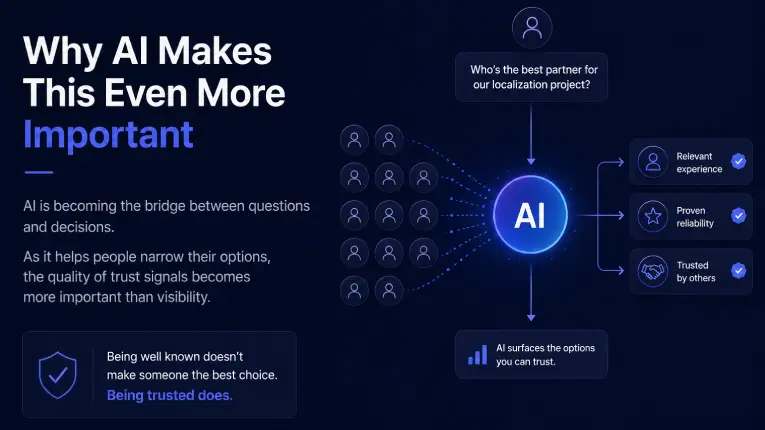
AI is gradually becoming an intermediary between questions and decisions. Instead of opening dozens of browser tabs to compare agencies, suppliers or consultants, people increasingly expect a single system to help them narrow their options. As that behaviour becomes more common, the quality of the underlying signals becomes far more important than simple visibility.
Being well known doesn't necessarily make someone the best recommendation.
Being trusted does.
The systems that help professionals discover opportunities over the next decade won't simply rank whoever attracts the most attention. They'll increasingly need to understand experience, relevance, reliability and context. In other words, they'll need to surface the kinds of signals that businesses have relied on for centuries but the internet has struggled to organize.
From Social Networks to Trust Networks
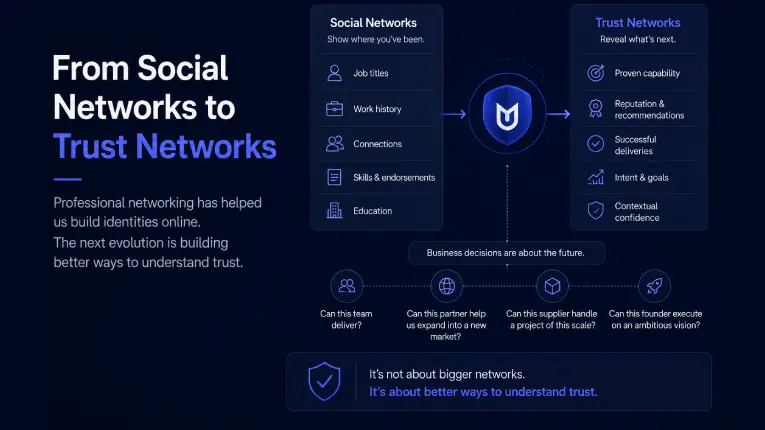
Professional networking has spent years helping people build identities online. We list our experience, describe our skills, collect connections and document where we've worked. Those profiles are valuable because they tell the story of where we've been.
Business decisions, however, are almost always about the future.
Can this team deliver?
Can this partner help us expand into a new market?
Can this supplier handle a project of this scale?
Can this founder execute on an ambitious vision?
Those questions aren't answered by job titles or connection counts alone. They require a deeper understanding of capability, reputation and intent. They require confidence that the person on the other side can actually deliver what they promise.
Perhaps that's the next evolution of professional networking. Not building larger networks, but building better ways to understand trust.
Why This Matters for Business Discovery
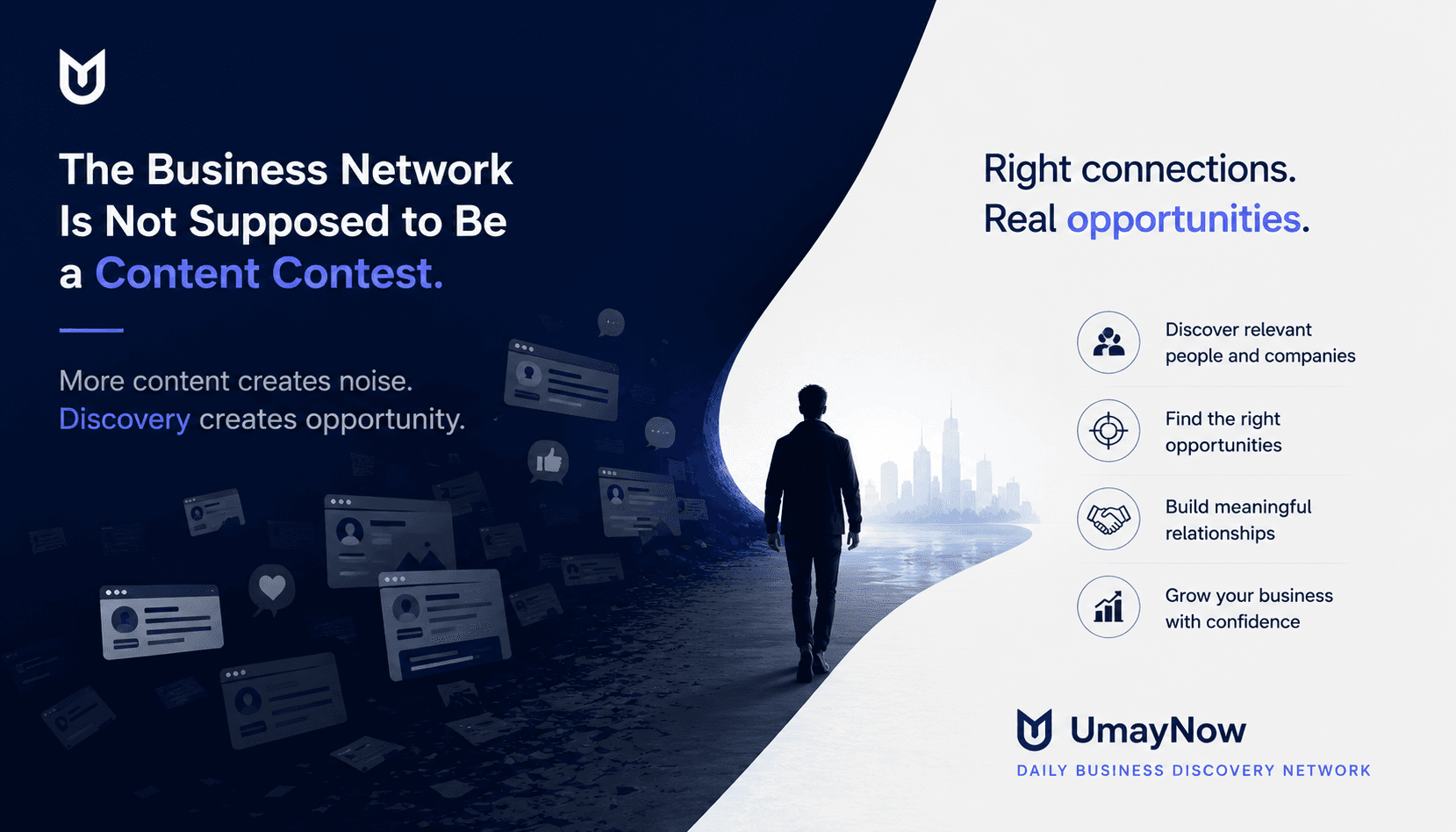
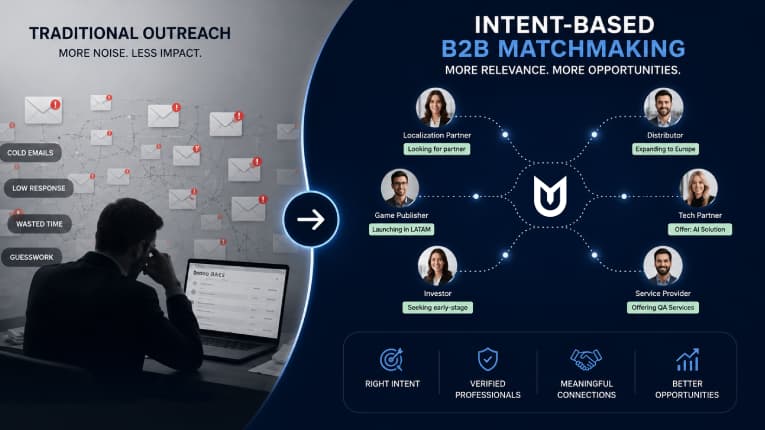
In our previous article, we argued that the next layer of the internet is Business Discovery. Search transformed how we find information, but business opportunities don't always begin with a search. Very often, they begin when the right people discover one another at exactly the right moment.
Discovery, however, is only part of the equation.
Finding an opportunity has little value if you can't judge whether it's worth pursuing. Every introduction, recommendation and potential partnership ultimately leads to the same question: Can I trust the person or company on the other side?
Business Discovery isn't only about making opportunities visible.
It's about making trustworthy opportunities easier to recognize.
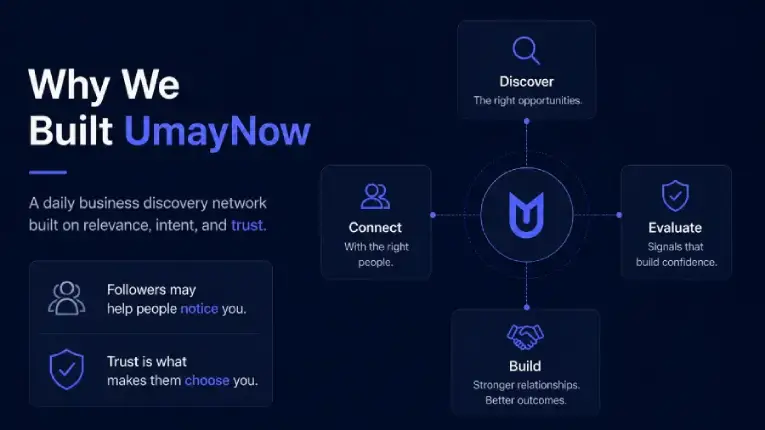
Why We Built UmayNow
Business has never suffered from a shortage of information. What it has lacked is a better way to discover the people and companies that inspire confidence before the first meeting ever takes place.
That's one of the ideas behind UmayNow.
We're building a Daily Business Discovery Network where opportunities are shaped not only by relevance and intent, but also by the signals that make professional relationships worth pursuing in the first place.
Search will remain one of the internet's greatest inventions, and professional profiles will continue to play an important role in how we present ourselves online. But as business becomes increasingly global and AI-assisted, trust will become one of the most valuable signals any platform can help surface.
Because followers may help people notice you.
Trust is what makes them choose you.