How Verification & Intent Matching Replace Search in Business Discovery
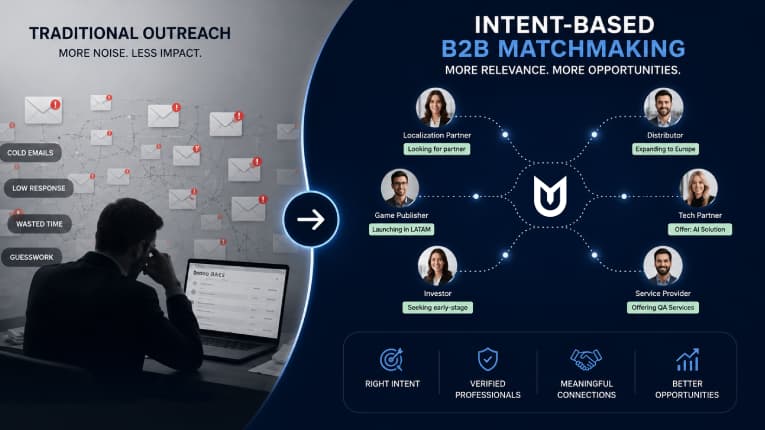
Search finds information. Business discovery should find opportunities. Here's why verification and intent matching are replacing traditional search in professional networking.
When Search Stops Working
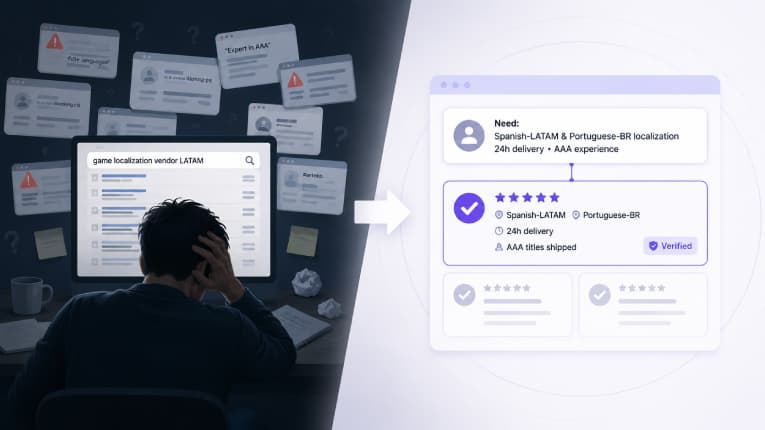
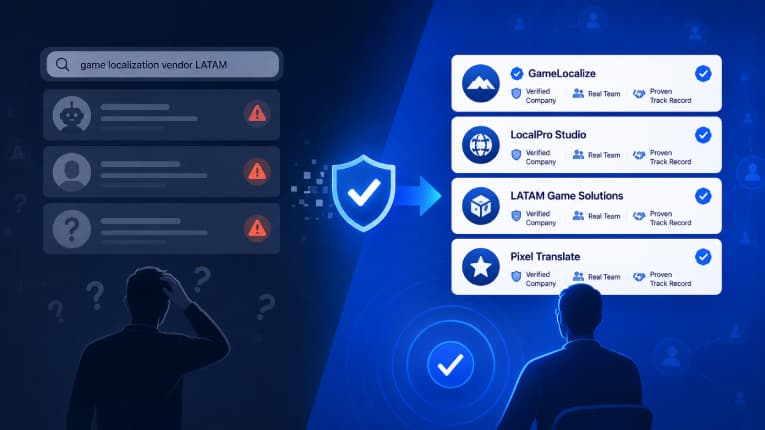
Imagine you're a localization director at a gaming studio. You need a vendor, someone who understands Spanish-Latin American and Portuguese-Brazilian localization, can deliver in 24 hours, and has shipped AAA titles.
You search: "game localization vendor LATAM"
Hundreds of results. Generic agencies claiming "40+ languages." Portfolio sites from 2023. One vendor claims expertise but has zero verifiable case studies. Two hours of scrolling later, you're more confused than when you started.
Search finds everything. It verifies nothing.
Traditional professional networks made this worse. They optimized for visibility of people and content, not for matching capability with need. A vendor posts about their services hoping you notice. You post a job listing hoping the right person applies. You're both searchable but never quite findable in the way that matters.
What if your platform knew what you needed, verified who could deliver it, and surfaced the exact match before you even searched?
Intent: The Layer Search Is Missing
Search is reactive. You search for what you want and hope relevant results appear.
Intent is proactive. The system understands what you need and what you offer—before you explicitly state it.
In traditional networks, intent is invisible. Your profile, posts, and activity exist, but the platform has no structured understanding of what you're actually trying to accomplish. Are you hiring? Partnering? Selling?
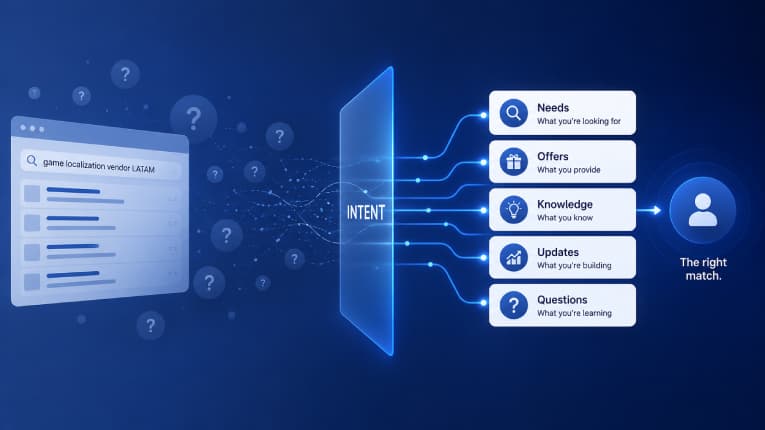
Intent-based discovery organizes professional activity into clear categories:
Needs: What are you looking for? (hiring for a CFO role, need a vendor, seeking a partner)
Offers: What do you provide? (localization services, fleet management, recruitment)
Knowledge: What do you know? (operational insights, industry expertise, best practices)
Updates: What are you building or achieving? (launched a new service, hit a milestone)
Questions: What are you learning? (seeking advice, exploring a new market)
When intent is explicit, matching becomes possible.
A localization director posting a specific need ("24-hour turnaround, AAA games, LATAM focus") isn't shouting into a void anymore. The system connects them with vendors who explicitly offer those capabilities. The vendor isn't hoping to be seen. They're directly matchable because their capabilities are structured and discoverable.
This is the difference between posting a job and being found for a job you're built to fill.
Verification: The Trust That Search Can't Provide
Here's what search results don't tell you: Are these people real? Can they actually deliver?
A company can claim anything. A professional can post about expertise they don't have. AI-generated profiles exist. Spam networks exist. Traditional networks tried to solve this with vanity metrics—follower counts, endorsements, profile views. But a profile with 50,000 followers might be a bot network. Hundreds of endorsements might be purchased.
When you're evaluating a potential partner, you shouldn't need to guess whether the business exists, whether the people are real, or whether previous collaborations actually happened. You should know.
Verification creates a trust layer that search cannot provide. In a verified ecosystem, companies are legally verified entities. Professional profiles are backed by identity verification. Opportunities are posted by real organizations, not bots. Recommendations come from professionals who've actually worked together. Over time, activity creates verifiable reputation.
Verification transforms a feed into a marketplace. It converts "profiles I hope are real" into "businesses I can confidently work with."
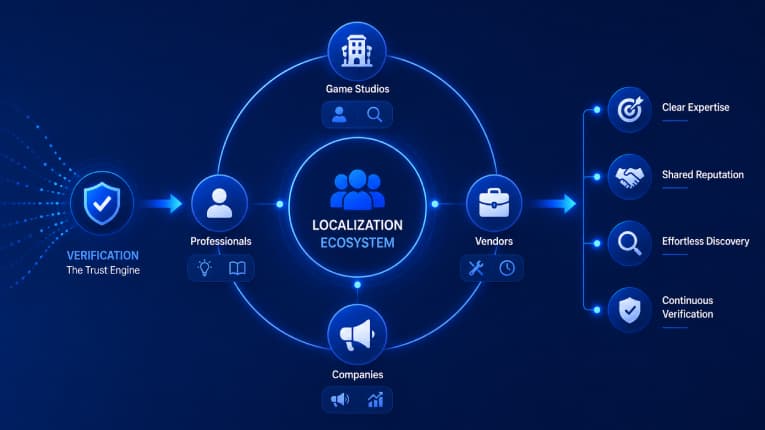
Why Ecosystems Matter: The Verification Engine
Verification works best when it's organized around shared context. This is where ecosystems become powerful.
Consider the localization ecosystem. Within it:
Game studios post hiring needs (localization directors, QA specialists)
Vendors post capabilities (multilingual expertise, CAT-tool integration, 24-hour turnaround)
Professionals share knowledge (localization best practices, cost optimization)
Companies announce updates (new language pairs, expanded capacity)
Because everyone in this ecosystem is there for localization-specific business, several things happen:
Expertise signals are clear. A professional claiming localization expertise is instantly verifiable through activity, recommendations, and past work. No one's claiming skills they don't have.
Reputation becomes visible and shared. When a vendor successfully connects with a game studio, that relationship becomes evidence for the next game studio. Trust compounds.
Discovery is effortless because intent is concentrated. You don't search for "localization vendors." The system shows verified vendors ranked by their success in your domain. Everyone there is looking for something specific. No noise. No irrelevant scrolling.
An ecosystem is a marketplace where verification is continuous, reputation is shared, and intent stays focused.
How This Reshapes Business Relationships
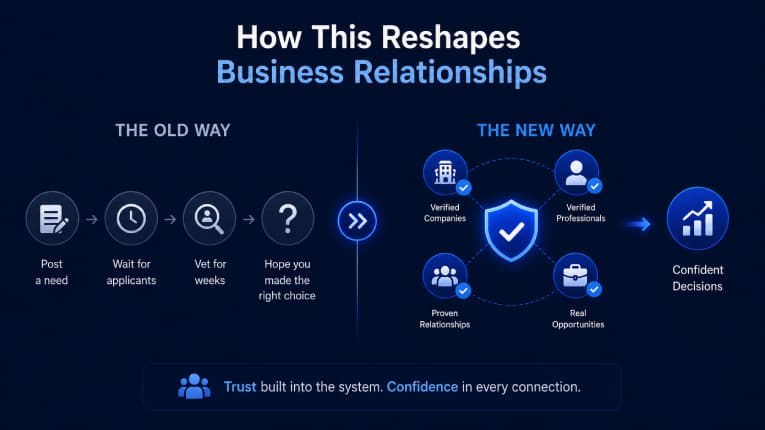
The old way: Post a need, wait for applicants, spend weeks vetting them, hope you made the right choice.
The new way: Your need is visible to verified professionals actively working in your domain. They know you're verified. They've seen others' successful experiences working with companies like yours. When they respond, you already have third-party signals of their capability.
The difference isn't just speed. It's confidence. The friction of verification is removed—not because we're trusting blindly, but because trust is built into the system.
A CEO in the fintech ecosystem, looking for a compliance-specialized contractor, doesn't need to vet resumes. They can see which contractors have successfully completed fintech compliance projects before. They can see recommendations from other fintech companies. They know the contractor is real, verified, and proven.
A logistics company looking for a fleet management partner can see other logistics companies using certain vendors. They see updates about performance improvements. They see the verified track record.
Search can't do this. Social networks can't do this. Only structured, verified ecosystems can.
The Evolution of Business Discovery
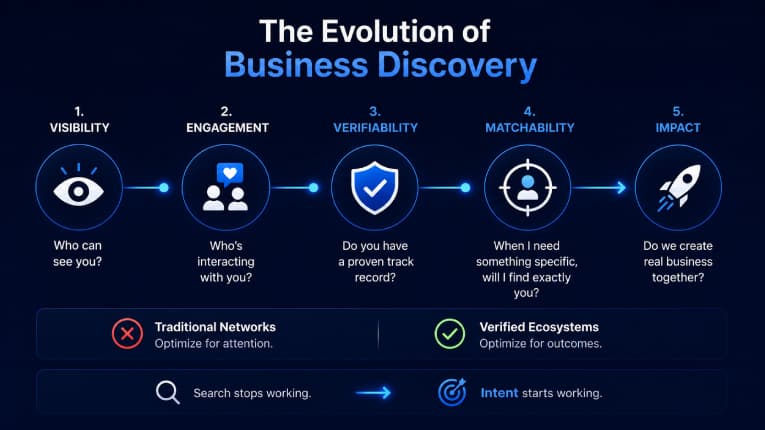
For decades, business was about visibility. Who can see you?
Then engagement. Who's interacting with you?
Now verifiability. Do you have a proven track record?
Soon, matchability. When I need something specific, will I find exactly you?
This isn't the future of professional networking. It's the next infrastructure layer of business itself.
Traditional networks optimized for attention. They built feed algorithms and visibility contests. Verified ecosystems optimize for outcomes. They organize around intent, build on verification, and concentrate expertise into niche communities where real business gets done.
The companies that will win aren't the ones shouting loudest. They're the ones most findable by the exact businesses that need them.
And that requires search to stop working.
It requires intent to start working instead.
What's Next
Every industry eventually develops trusted communities. These aren't LinkedIn groups or broad job boards. They're focused spaces where intent is structured, verification is built-in, and matching is effortless.
If you're still posting generic job listings and hoping the right people see them, searching for vendors on Google, or building relationships through broad professional networks—you're still playing the search game.
What if your industry had a dedicated ecosystem instead?
We're building this at UmayNow. If you want to explore how business discovery could work in your industry, let's talk.
Read next: The Future of Professional Networking Is Business Discovery